
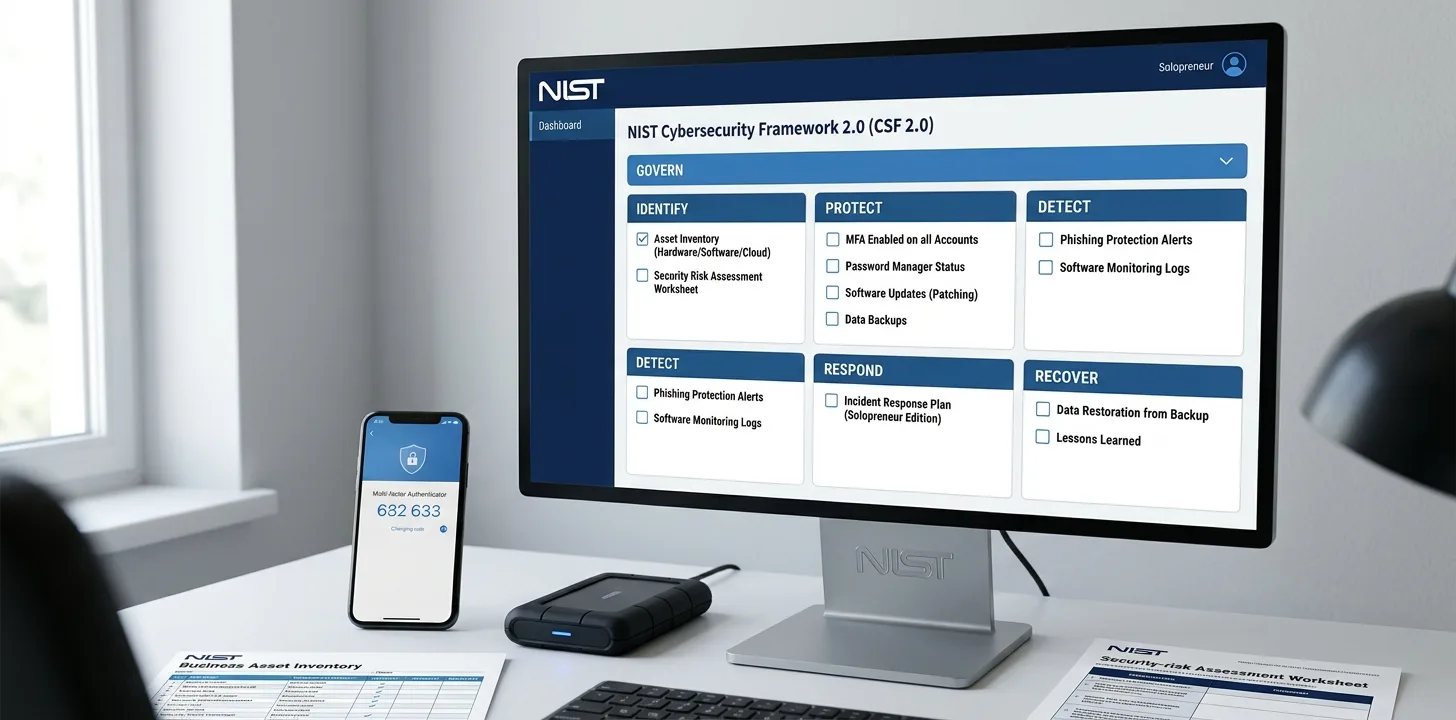
Cybersecurity for freelancers just got an official starting point. On November 2, 2026, the US National Institute of Standards and Technology (NIST) released Small Business Cybersecurity: Non-Employer Firms (CSWP 50). It is a free, plain-language guide for people who run a business alone. According to NIST's announcement, it assumes no prior security knowledge.
Who the NIST guide is for
The guide targets solopreneurs, meaning businesses where the owner is the only paid employee. NIST says more than 28 million US small businesses fit that description. Freelancers, contractors and sole traders elsewhere can use it too, because the advice is general.
The first steps NIST recommends
- Back up your data regularly. Keep copies you can restore if a device is lost or hit by ransomware.
- Keep software updated. Turn on automatic updates for your operating system, browser and apps.
- Change default passwords on networked devices such as your Wi-Fi router. Use unique, strong passwords instead.
- Review security settings on every device you use for work.
- Plan for growth. As you add devices or help, set up simple rules for adding devices and managing passwords.
Each action in the guide explains why it matters, how to start, how to improve later, and which part of the NIST Cybersecurity Framework (CSF 2.0) it relates to.
The two worksheets
| Worksheet | What it helps you do |
|---|---|
| At-risk assets inventory | List the devices, accounts and data your business depends on. |
| Actions tracker | Record what you have done and what is still on your list. |
The guide also walks through three example businesses: a lawyer, an artisan and a business consultant. Pick the one closest to you and copy its approach.
Cybersecurity for freelancers: why it matters
A one-person business usually has no IT team. Your laptop, phone, email and cloud accounts hold client files, invoices and payment details. One lost device or hijacked email account can stop your work for days. The NIST guide is built for exactly this situation.
A 30-minute starter plan
- Write down every device and online account you use for work.
- Turn on automatic updates on each device.
- Log in to your router and change the default admin password.
- Set up an automatic backup for your work files.
- Move your passwords into a password manager and switch on two-step verification for email and banking.
What the guide does not do
NIST co-author Daniel Eliot says the publication "is not comprehensive and won't address all the needs of every solopreneur." It replaces the older NISTIR 7621 and focuses on protecting digital systems from attack. Treat it as a foundation, not a full security programme.
Frequently Asked Questions
Does the guide include examples?
Yes. It walks through three hypothetical one-person businesses: a lawyer, an artisan and a business consultant. Each shows how a different kind of solo business can apply the same steps.
What replaced NISTIR 7621?
CSWP 50 updates what was previously titled Small Business Information Security: The Fundamentals (NISTIR 7621), with a narrower focus on one-person firms.
What is NIST CSWP 50?
It is NIST's guide Small Business Cybersecurity: Non-Employer Firms, released on November 2, 2026 for one-person businesses.
Is the NIST solopreneur guide free?
Yes. You can read and download it from NIST's website.
Do I need security experience to use it?
No. NIST says it is written in plain language and assumes no prior knowledge.
Summary
NIST's CSWP 50 gives freelancers and solopreneurs a free, simple cybersecurity plan. Start with backups, updates, new router passwords and a review of device settings. Then use the two worksheets to track your progress.
Related articles
Sources
We cover gaming, software, tech, AI and trading. Every story links to its primary sources, and rumours are labelled as such. Spotted a mistake? Let us know and we will correct it.
Comments
Loading comments…