
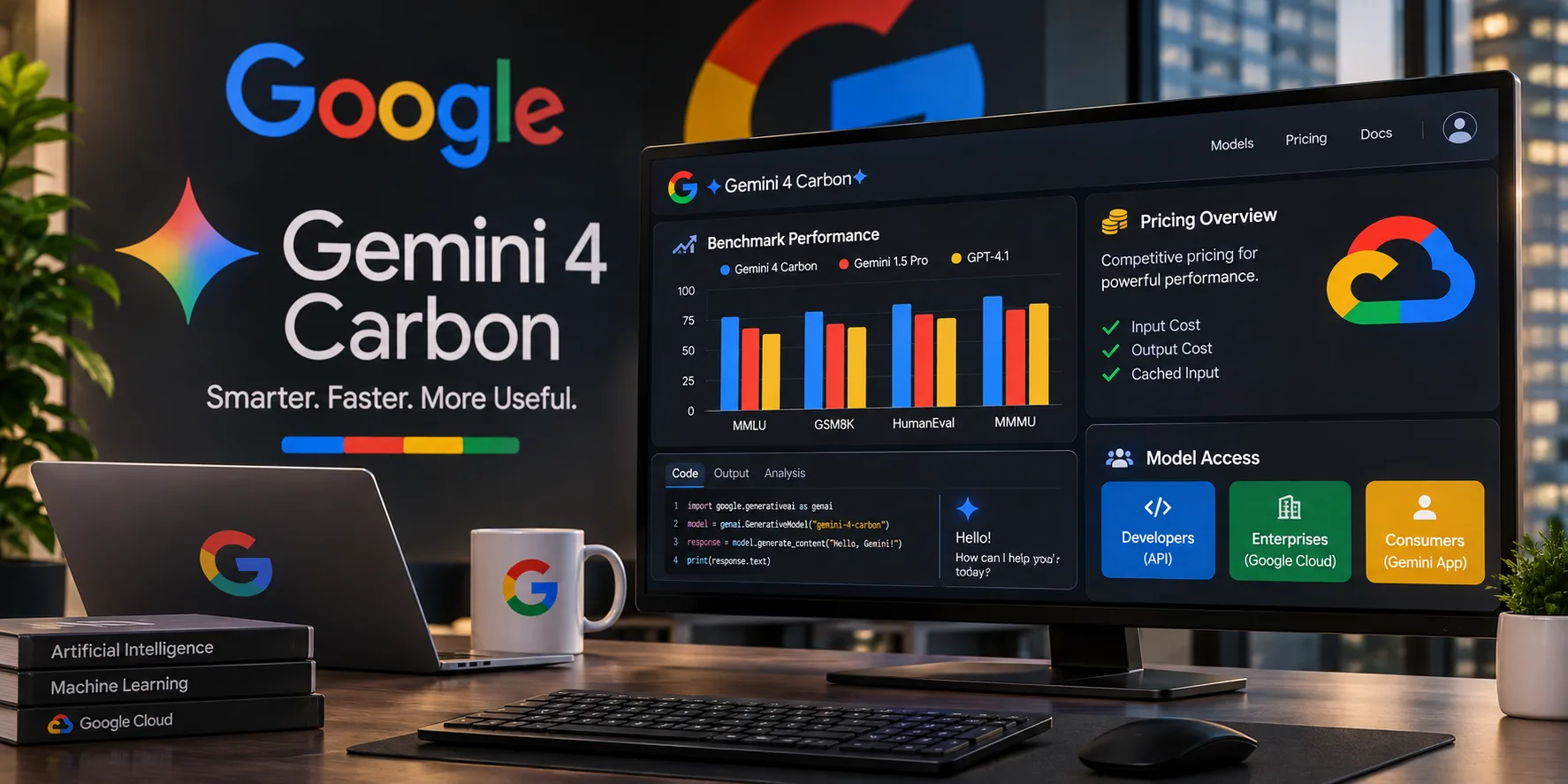
Gemini 4 Carbon is Google's newest frontier model, announced on October 28, 2026. Google calls it its strongest model, with state-of-the-art cybersecurity skills and the ability to work on long, multi-step engineering tasks. It arrived two weeks after Gemini 4 Argon. For now, only a small group of cyber defenders can use it. All details below come from Google's official announcement.
Gemini 4 Carbon benchmarks
| Benchmark | What it tests | Carbon result |
|---|---|---|
| Artificial Analysis Intelligence Index v5.0 | General intelligence | 59, ranked #1 |
| SEC-bench Pro | Finding vulnerabilities | 88.2% |
| ExploitGym | Exploiting vulnerabilities | 54.8% |
| CWE-bench | Patching vulnerabilities | 71.0% |
| WebDev Arena | Web development | 1768 Elo, ranked #4 |
Google says the external benchmarks were run without guardrails. Its Chrome team reported more than 10 times better patch quality than another lab's large frontier model.
What Carbon is good at
- Long agentic engineering. Google says internal teams have seen it run for days, working through dead ends and patching bugs in large codebases.
- Security work. Finding, validating and fixing vulnerabilities.
- Broad gains in coding, science tasks, full-stack web development and multimodal understanding.
Gemini 4 Carbon price
| Period | Input (per 1M tokens) | Output (per 1M tokens) |
|---|---|---|
| Introductory (same as Argon) | $2 | $10 |
| After the introductory period | $4 | $20 |
Cached input is 95% off the input price. Google has not said when the introductory period ends.
Who can use Gemini 4 Carbon
- Now: a subset of cyber defenders.
- Next: more trusted partners, added gradually through Google's Fairwind Program.
- Later: developers, businesses and consumers, "as soon as possible", after more feedback and guardrail work.
Google is also taking part in the US government's voluntary pre-release model testing process.
How Carbon compares with Gemini 4 Argon
In Google's internal tests, Carbon:
- Cuts unsupported claims by about half.
- Reduces overreach by 26% and under-service by 29%.
- More than doubles the success rate on secure code generation.
- Drops prompt-injection attack success from 0.7% to 0.0% on the Gray Swan benchmark.
Safety measures
Carbon uses the same layered safety stack as Argon: training, real-time misuse defences, prompt-injection resistance and chain-of-thought monitoring. Google reports successful cheating on Terminal-Bench 4.0 fell to 0.0%. High-severity misalignment alerts in internal live coding dropped by almost 80%. The slow rollout reflects how powerful its security skills are.
Why access is limited at first
A model that is very good at finding and exploiting vulnerabilities can help defenders and attackers alike. Google's plan puts Carbon in the hands of cyber defenders first, then trusted partners, before a wider release. Google's quote sums up the approach: "Pushing the frontier forward requires moving fast while remaining deliberate about deployment."
What it means for developers
- Plan, but do not build on it yet. There is no general API access, and Google has not published a full API specification.
- Budget for the price rise. Input and output prices double after the introductory period.
- Use caching. The 95% discount on cached input makes long, repeated contexts much cheaper.
- Use Argon in the meantime. It shares Carbon's introductory price and is the closest available model.
Frequently Asked Questions
Who wrote the Gemini 4 Carbon announcement?
Koray Kavukcuoglu, SVP at Google DeepMind and Chief AI Architect at Google.
When was Gemini 4 Carbon released?
Google announced it on October 28, 2026, with access starting that week for a subset of cyber defenders.
Can I use Gemini 4 Carbon in the Gemini app?
Not yet. Google says consumers, developers and businesses will get access later.
How much does Gemini 4 Carbon cost?
$2 per million input tokens and $10 per million output tokens at the introductory price, rising to $4 and $20 later.
Summary
Gemini 4 Carbon is Google's strongest model and ranks first on the Artificial Analysis index at 59. It leads on security benchmarks and long coding tasks, costs $2 and $10 per million tokens at launch, and is limited to cyber defenders for now.
Related articles
We cover gaming, software, tech, AI and trading. Every story links to its primary sources, and rumours are labelled as such. Spotted a mistake? Let us know and we will correct it.
Comments
Loading comments…